
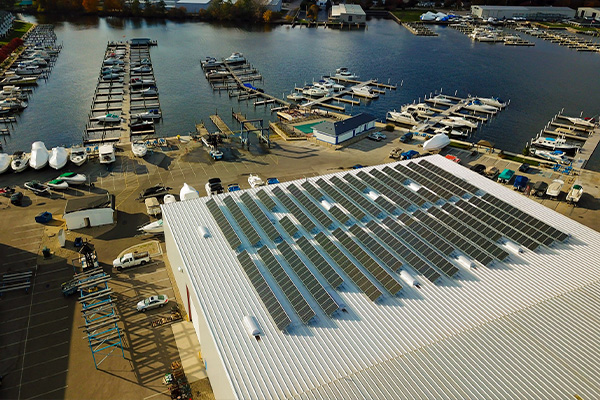
If your business is weighing solar, the date that matters most now is December 31, 2027. Commercial solar projects that did not begin construction by July 4, 2026 generally must be placed in service by the end of 2027 to claim the federal commercial solar tax credit (the Section 48E clean electricity investment credit). This guide explains what that means, what changed in 2026, and how to plan a project so it finishes in time.
The commercial solar tax credit in one paragraph
The Section 48E credit lets a business subtract a share of a solar project’s eligible cost directly from its federal tax bill. For most commercial projects the credit is 30%: systems under 1 MW (AC) get the full rate automatically, and larger systems get it by meeting prevailing-wage and apprenticeship rules. Since the 2025 tax law (the “One Big Beautiful Bill”), solar has a hard end date that depends on when construction began:
| Your project | Deadline to qualify |
|---|---|
| Began construction on or before July 4, 2026 | Generally must be placed in service by the end of the 4th calendar year after construction began (as late as Dec 31, 2030) |
| Began construction after July 4, 2026 (most projects starting now) | Must be placed in service by December 31, 2027 |
The credit is separate from depreciation. Businesses that own their system can usually claim both.
What “placed in service” means
A solar system is placed in service when it is finished, tested, and ready and available to produce power for its intended use. Signing a contract, buying equipment or starting installation is not enough.
For energy projects, the IRS and the courts have looked at several factors:
- All required permits and approvals have been obtained
- Pre-operational testing is complete
- The owner has control of the system
- The system is synchronized with the grid
- Daily operation has begun, or could begin
Industry sources disagree on whether the utility’s formal permission to operate is strictly required. The safe plan is to have the system built, inspected, interconnected and producing before December 31, 2027, with paperwork showing each step. Your tax advisor makes the final call for your situation.
What changed in 2026
A court restored the 5% safe harbor in June, but it doesn’t help new projects
In 2025, IRS Notice 2025-42 removed the “5% safe harbor,” a way to prove construction had begun by spending 5% of a project’s cost. In June 2026, a federal court in Washington, D.C. vacated that notice and restored the older rules. That mattered to projects racing the July 4, 2026 start date. For projects starting now, it changes nothing: the December 31, 2027 placed-in-service date applies either way.
FEOC rules now cover where equipment comes from
For projects that begin construction in 2026 or later, the credit depends on where the equipment comes from. Under the “foreign entity of concern” (FEOC) or “material assistance” rules, no more than a set share of a project’s component cost can come from prohibited foreign entities, mainly companies tied to China. Interim Treasury guidance (Notice 2026-15) sets the bar this way:
- Solar: at least 40% of the project’s component cost must come from compliant sources for projects that start construction in 2026, and the share rises each year after that
- Battery storage: a higher bar, 55% in 2026
Treasury is due to publish the detailed tables used for this calculation by the end of 2026. Until then, ask your installer to document where the modules, inverters and racking come from. US manufacturing helps, but the test is based on who made each component, not just where the box shipped from. SunMatic typically installs Qcells panels and SolarEdge inverters, both of which manufacture in the United States.
How long a commercial solar project takes
Every project is different, and its timeline depends on its own challenges. The steps are the same, though, and utility interconnection is usually the longest one. Here’s what to expect, based on SunMatic’s experience in Michigan:
| Step | What to expect |
|---|---|
| Site assessment | About 1–2 weeks on average; longer if the site has environmental requirements |
| Design and engineering | Depends on system size and site complexity |
| Permits | Highly variable, depending on your jurisdiction and system size |
| Utility interconnection (Consumers Energy) | Usually the longest step, averaging 1–2 months |
| Installation | Depends on system size, mounting type, season and crew scheduling |
| Inspection, testing and permission to operate | The final step before the system can count as placed in service |
Building through a Michigan winter
Winter slows some projects but doesn’t stop them. At SunMatic, we work to get ground screws installed before the frost sets in, which lets us keep building ground-mount systems year-round. Rooftop work continues through the winter too, but it depends on snow, weather, roof pitch and crew safety, so a rooftop project that slips into January carries more schedule risk.
Aim to finish by October 2027
Don’t plan to finish in December. We recommend having the system complete by about October 2027, which leaves room to resolve any interconnection issues, inspections or weather delays before the December 31 deadline. Work backward from there: the earlier your site assessment happens, the more cushion you have. Also ask any installer when their crews can realistically start building, not just how long the build takes.
Four ways to protect your credit
- Start early. Interconnection is the step you control least, so get the design done and the application in as soon as you can.
- Get equipment sourcing in writing. Ask for documentation of where major components come from, not a verbal assurance.
- Bring in your CPA now, not at tax time. Confirm you can use the credit (or how a PPA owner would), how it interacts with depreciation, and which tax year it lands in.
- Deal with the roof first. If your roof needs repair or replacement, finding out late can cost months. See can my commercial roof support solar?
Does solar still make sense without the credit?
Often, yes. The credit speeds up payback, but the long-term case rests on rising utility rates and how much of the power you use on-site. Michigan regulators approved large electric rate increases in 2026, and more have been requested. A good proposal shows your numbers with and without the credit, so the decision doesn’t hinge on a deadline. See what commercial solar costs in Michigan and when is the best time to build solar.
Find out whether your project can make the deadline
SunMatic Solar® has designed, engineered and installed commercial and industrial solar across Michigan, Ohio and Illinois for more than 10 years, and the arrays we’ve built produce more than 4 GWh of electricity every year. Request a free savings estimate or call (231) 683-2111. We’ll model your facility and give you an honest read on the timeline.
Frequently asked questions
What is the deadline for the commercial solar tax credit?
For commercial solar projects that began construction after July 4, 2026, the system generally must be placed in service by December 31, 2027 to claim the Section 48E credit. Projects that began construction earlier usually have until the end of the fourth year after construction began.
Does “placed in service” require utility permission to operate?
Sources disagree on whether it’s strictly required. The safest approach is to have the system installed, inspected, interconnected and producing before December 31, 2027, with documentation of each step, and to confirm the details with your tax advisor.
When should my project be finished to be safe?
Aim to be complete by about October 2027. That leaves a cushion to resolve interconnection issues, inspections or weather delays before the December 31, 2027 deadline.
Can I still use the 5% safe harbor?
Not to avoid the 2027 deadline. A June 2026 court ruling restored the 5% safe harbor, but beginning construction only extends the deadline for projects that started on or before July 4, 2026, and that date has passed.
Do the FEOC rules apply to my project?
Yes, if construction begins in 2026 or later. A minimum share of the project’s component cost must come from non-prohibited sources: 40% for solar starting in 2026, rising each year. Ask your installer to document where the equipment comes from.
Does the 2027 deadline apply to battery storage?
No. Energy storage follows a separate, longer credit schedule, although it faces stricter FEOC sourcing rules. A battery makes sense when it pays for itself, usually by reducing demand charges, and SunMatic can evaluate whether storage fits your facility.
Can I get the credit with a PPA?
With a power purchase agreement, the third-party owner claims the credit and passes some of the value on through a lower power price. The same placed-in-service deadline applies to the system.
Written by Liam Sandy, Solar Analyst and Data Scientist at SunMatic Solar. Last updated: November 2026. This article is general information, not tax or legal advice. Federal tax rules and Treasury guidance are changing; consult your tax advisor about your project.